
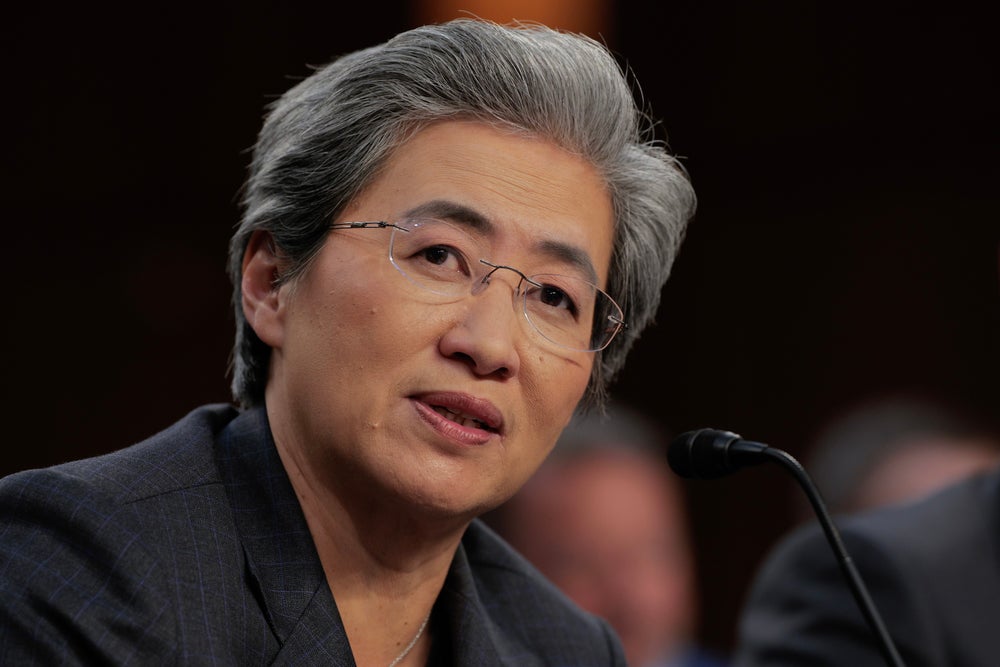

She Built a $200 Billion Empire — But She’s Still Nowhere Near Nvidia’s CEO. Why?
Lisa Su did the impossible.
She took a dying chipmaker, AMD, and turned it into a tech powerhouse. Under her leadership, AMD’s stock has skyrocketed by more than 7,000%. That’s not a typo.
And yet — despite pulling off one of the greatest corporate comebacks in tech history, Lisa Su’s personal fortune is a tiny fraction of what Nvidia CEO Jensen Huang is worth.
How tiny?
Let’s put it this way:
Lisa Su’s net worth is around $740 million.
Jensen Huang? He’s now worth over $40 billion — and counting.
That’s more than 50 times richer, even though AMD’s rise is nothing short of legendary.
So what’s really going on here?
One Is a Founder. The Other Was Hired.
This is the BIGGEST reason — and it’s brutal.
Jensen Huang co-founded Nvidia in 1993. That means he started with a massive chunk of ownership when shares were worth practically nothing.
As Nvidia exploded, his early equity became worth billions.
Lisa Su didn’t found AMD. She joined as a senior leader in 2012 and became CEO in 2014. Her compensation came in the form of performance-based stock options, not founder-level equity.
Translation?
Huang’s wealth grew just by holding onto his shares.
Su had to earn every inch of her net worth — with results, performance, and board approvals.
Nvidia Rode the AI Hype Train — Hard
Let’s be real: Nvidia is the face of the AI revolution right now.
Every tech company, every cloud provider, every AI model — they all run on Nvidia’s GPUs.
This demand pushed Nvidia’s valuation past $3 trillion, making it one of the most valuable companies on Earth. And guess what? Huang’s net worth skyrocketed along with it.
AMD, while competitive, hasn’t captured the same AI spotlight — at least, not yet.
So while AMD grew steadily and impressively under Su, Nvidia exploded — and Huang went along for the ride.
Equity Isn’t Equal
Here’s a detail most people miss: Not all stock is created equal.
Huang’s shares? Founder stock, bought dirt-cheap, no strings attached.
Su’s shares? Mostly performance-based RSUs (restricted stock units) that vest over time and depend on company goals being hit. Also: she gets fewer of them because she didn’t start the company.
Even if AMD’s value keeps growing, Su’s equity is capped, regulated, and structured. Huang’s is free to grow — and it’s been growing fast.
Public Perception Drives Wealth… Even When It Shouldn’t
Here’s a hard pill to swallow: Wall Street worships founders.
Even though Su did all the heavy lifting to rebuild AMD, Huang is seen as the “visionary” who “saw the AI future” before anyone else.
Investors throw money at Nvidia based on Huang’s vision.
AMD? Despite its massive progress, it’s still considered the underdog.
That perception gap plays a huge role in stock performance — and in how rich CEOs get.
So… Is Lisa Su Being Undervalued?
Absolutely.
She saved a sinking ship.
She crushed Intel in the CPU wars.
She rebuilt trust with gamers, investors, and clients.
And she positioned AMD as a major player in data centers, gaming, and AI.
Yet her net worth still trails behind not just Huang — but many lesser-known, less-impactful tech leaders.
If Lisa Su were the founder of AMD? She’d easily be worth tens of billions by now.
The Most Ironic Part?
Lisa Su may have created more shareholder value than almost any other tech CEO of the past decade.
But she’s still not on the billionaire leaderboard. Why?
Because the system rewards those who were there first — not always the ones who do the hard work.
Don’t Count Her Out Yet…
Here’s the twist: AMD is now gunning for AI dominance, launching new chips to directly compete with Nvidia’s.
If Su pulls it off?
If AMD gains serious market share in AI infrastructure?
Her net worth could skyrocket.
And Wall Street may finally realize what fans of AMD have known for years:
Lisa Su didn’t just save a company — she changed the game.




