
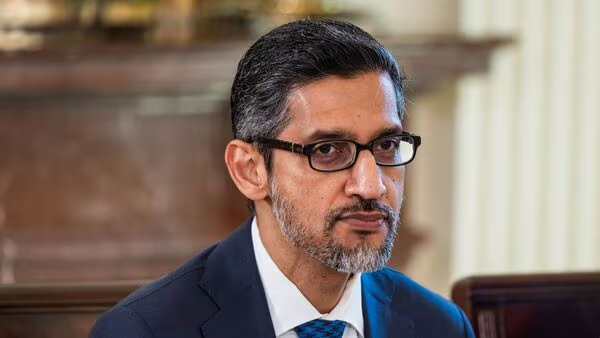

In a jaw-dropping revelation, Sundar Pichai, CEO of Alphabet and Google, admitted in a BBC interview that AI might one day replace CEOs — including himself.
While most people worry about AI taking over routine jobs, Pichai’s comments suggest that no position is safe, not even the corner office.
AI Threatening Top Jobs?
When asked if AI could threaten all jobs, including his own, Pichai responded with a subtle smile, hinting that:
- AI could handle complex executive decisions
- Leadership roles might become “one of the easier things” for AI to perform
- Even the highest-ranking positions could be vulnerable in the near future
This is a stark warning for companies worldwide: the rise of AI isn’t limited to factory floors or office cubicles.
How AI Could Replace CEOs
Traditionally, CEOs make strategic decisions, manage operations, and lead teams. But AI is evolving fast:
- It can analyze massive datasets instantly
- Optimize complex business operations in real time
- Make data-driven decisions faster than humans
Soon, AI could theoretically perform leadership tasks, from planning mergers to managing global operations — challenging the notion that executive roles are untouchable.
The Bigger Picture
Pichai’s warning highlights a new era for the future of work:
- AI could disrupt knowledge-based and executive roles
- Businesses may need to redefine leadership in the age of intelligent machines
- Ethical questions will emerge about AI making critical corporate decisions
The message is clear: no one, not even CEOs, is immune from the AI revolution.
What This Means for the Corporate World
- Executives must adapt and integrate AI to stay relevant
- Companies might rethink hierarchies and decision-making structures
- Leaders must prepare for a world where AI could be their ultimate colleague — or replacement
Pichai’s candid remarks force the corporate world to confront a reality many are only beginning to grasp.
Sundar Pichai’s admission that AI could replace CEOs — including himself — is a wake-up call for the entire business ecosystem. The era of intelligent machines is no longer just a futuristic concept; it’s a real and present challenge that could reshape the way companies operate, from the ground floor to the boardroom.




