
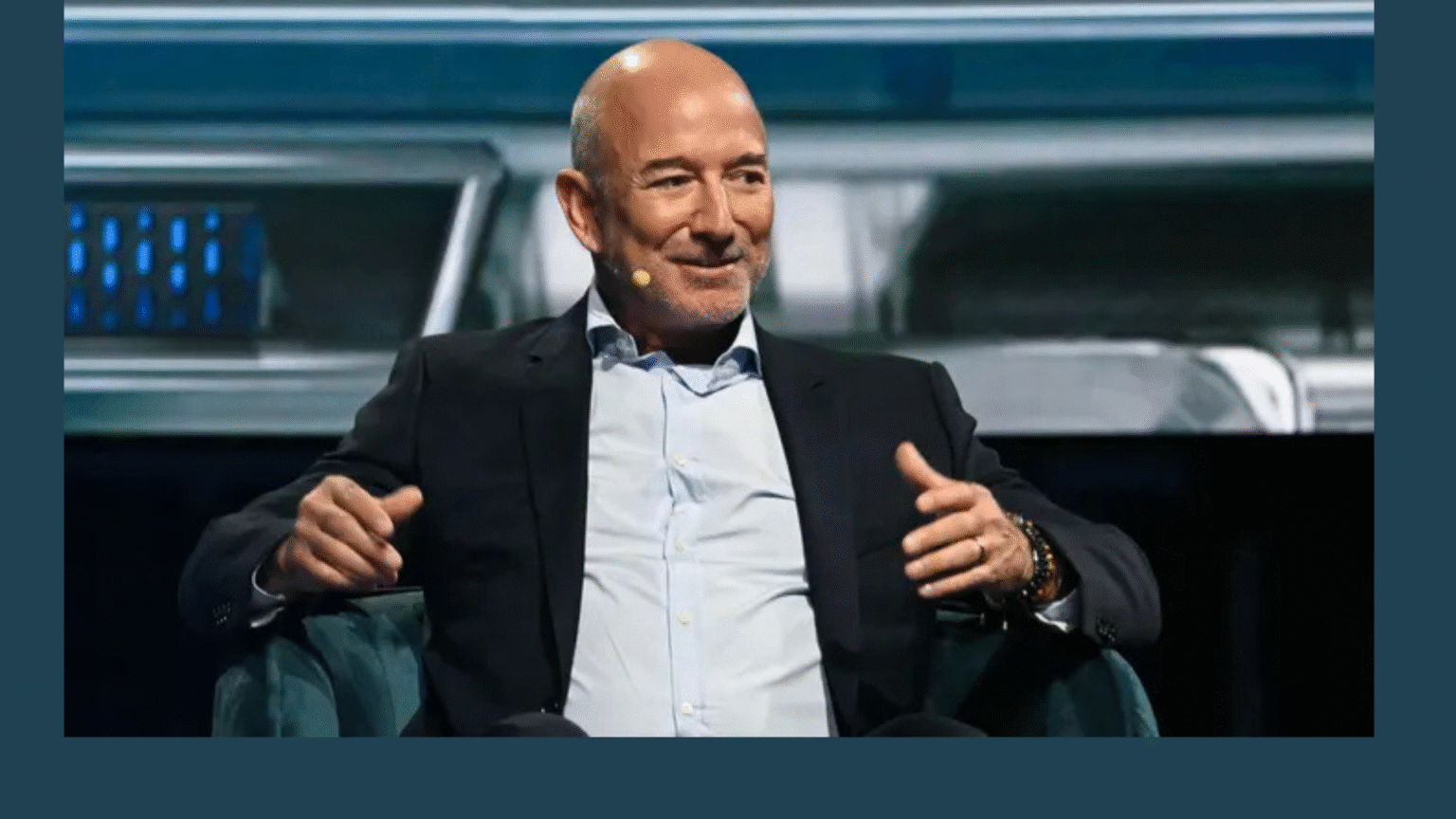

The move has electrified the global technology landscape because, for the first time since he left Amazon in 2021, Jeff Bezos has stepped back into an operational leadership role. The world’s third-richest man has just been named co-CEO of a new artificial intelligence startup, Project Prometheus, which has already raised more than $6 billion in funding. Alongside him is Vik Bajaj, a respected scientist-entrepreneur whose brand of expertise runs deep in avant-garde biotech and advanced research. Together, they will shape what could easily become one of the most ambitious AI ventures of the decade.
Project Prometheus is not just another AI company emerging in an already crowded space. Instead, it positions itself on the frontier of “AI for the physical world”: applying intelligence to manufacturing, robotics, aerospace, automotive engineering, and complex industrial systems. While most AI startups focus on software-based tools, chatbots, or enterprise automation, Prometheus aims to merge AI with real-world engineering challenges-a segment many believe represents the next trillion-dollar opportunity.
Bezos Returns to the Trenches
Jeff Bezos’s decision to return to a hands-on leadership role is significant, as he has kept a large part of his focus on philanthropy, Blue Origin, and personal investments since stepping down as the CEO of Amazon. His move into Project Prometheus would therefore signal strong personal conviction-this is not an investor role but a full operational comeback.
Bezos has long championed the idea of long-horizon technological bets. With Amazon, he disrupted e-commerce; with AWS, he reshaped cloud computing; and with Blue Origin, he entered the private space race. Now, with Project Prometheus, he seems ready to influence the next technological revolution: the integration of AI into the physical economy.
His presence means not only capital and global attention but also proven experience in scaling complex, infrastructure-heavy operations-a critical advantage in an AI sector moving beyond digital boundaries.
Vik Bajaj: The Scientific Counterpart
While Bezos brings global leadership and business vision, co-CEO Vik Bajaj brings deep scientific and technical acumen. A PhD from MIT, Bajaj was a key leader at Google X and co-founded several research-driven enterprises. From artificial intelligence to material science, his background includes experience in biotech and advanced computing, making him an ideal technical head for a company tackling the intersection of AI and physical systems.
The appointment of Bajaj is a signal that Project Prometheus will not be an overly commercial AI venture but rather a research-heavy, tech-intensive company that may push the limits of scientific understanding in fields like robotics, simulations, automation, and engineered materials.
Together, Bezos and Bajaj form a complementary leadership duo: one driven by visionary scaling, the other by deep technical mastery.
A $6.2 Billion Bet on the Future of AI
What makes Project Prometheus different, however, is the truly extraordinary amount of capital it has been able to raise at its inception. It will boast more than $6 billion of funding, placing it among the best-financed AI startups in the world at launch. That financial heft will give the company considerable freedom to hire A-list research talent, construct advanced hardware infrastructure, and build ambitious prototypes without the normally tight pressures seen in early-stage startups.
Prometheus reportedly already attracted an elite group of engineers and researchers from OpenAI, Google DeepMind, Meta, Tesla, and Apple. This calibre of talent suggests that the company may attempt much more than incremental AI improvements.
Redefining AI Beyond Screens
Its central mission seems to be the expansion of AI beyond text, images, and digital automation; rather, it seeks to embed intelligence into the physical world: AI-driven factories, robots that can adapt in real time, aerospace systems optimized via machine reasoning, hardware built with computational assistance.
It has the potential to be an international paradigm shift in industries. Manufacturing can be faster, cheaper, and more precise. Robotics could finally achieve dexterity and autonomy for real-world application. Transportation, energy, and industrial engineering might experience dramatic improvements.
If successful, Project Prometheus may well be a cornerstone of what many analysts refer to as the “physical AI revolution.”
Industry Impact and What Comes Next
Bezos and Bajaj coming together as co-CEOs sends an emphatic message: the era of AI is entering a new phase. No longer confined to screens or data centers, AI is marching towards real-world infrastructure, machinery, and industrial systems.
This move might accelerate funding into deep-tech and industrial AI for founders, investors, and innovators around the world; it could spark a competitive race for traditional manufacturers to adopt next-generation intelligent systems. And for tech ecosystems, the partnership between Bezos and Bajaj sets the bar for leadership in the high-stakes frontier industry. Conclusion Jeff Bezos and Vik Bajaj at the helm of Project Prometheus represent one of the most ambitious leadership pairs to hit the AI world to date. Their combined skillset-Bezos the visionary leader, Bajaj the scientific braintrust-positions the startup to potentially upend the way that AI interacts with the physical world. With vast funding, elite talent, and a bold mission, Project Prometheus could become a defining force in the next wave of technological innovation.




